
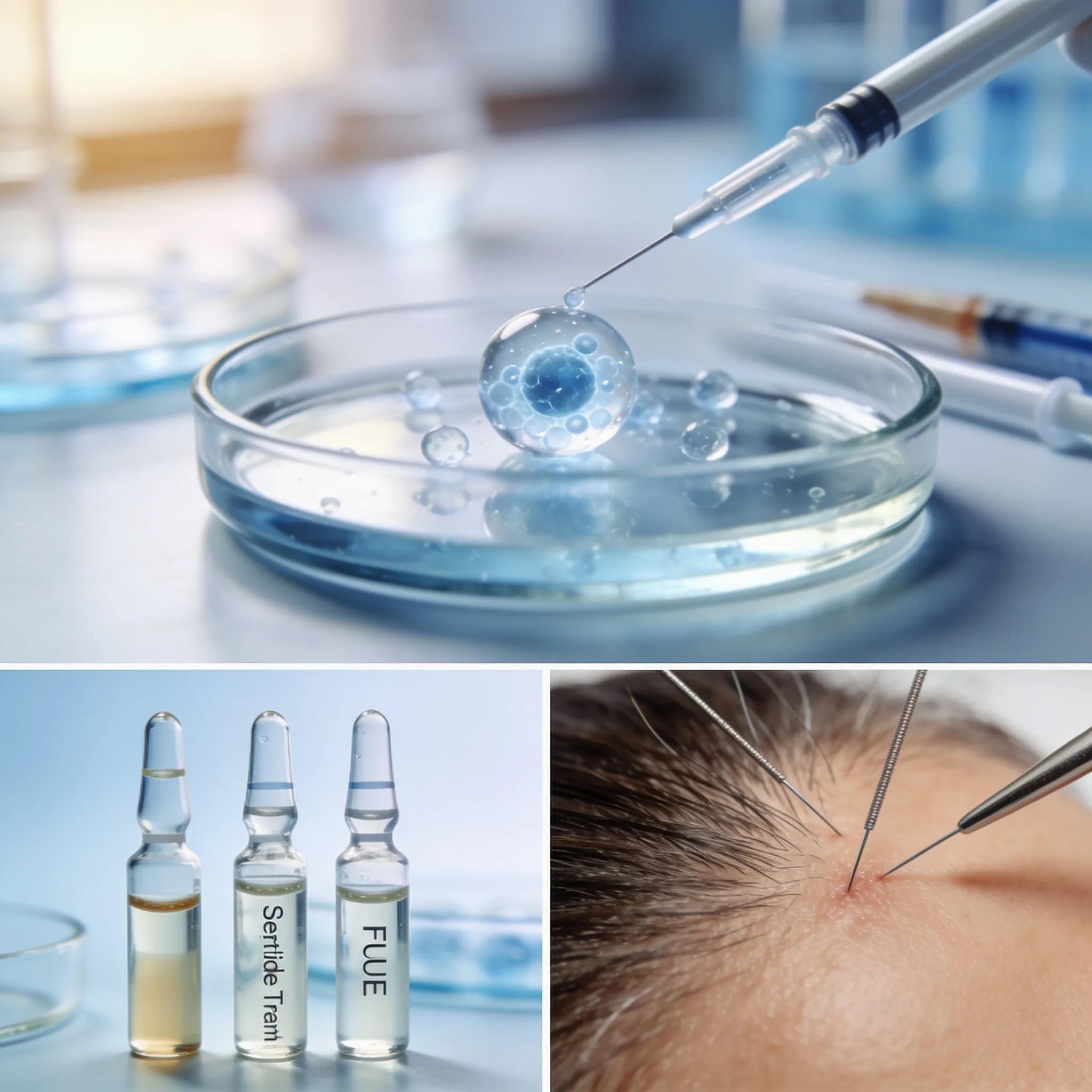
Stem Cells vs Exosomes vs PRP for Hair: What the Evidence Compares
Medically reviewed by Dr. Charles Pereyra, MD — Medical Director, Springs Rejuvenation. Last reviewed October 28, 2026.
Written by the Springs Rejuvenation regenerative medicine team from direct clinical experience administering stem cell and exosome protocols at our Aventura, Miami center.
Hair restoration options have expanded beyond surgical transplantation to include regenerative approaches that aim to support existing follicles or augment graft survival. Three biologics frequently discussed are platelet-rich plasma (PRP), exosome preparations, and stem cells. Each carries different mechanisms, distinct evidence bases, and varying levels of regulatory oversight. Understanding how these modalities differ—and what the published literature actually shows—helps patients ask informed questions during physician consultations.
This article reviews the investigational science behind each approach, examines candidacy considerations, and describes how physician-supervised protocols integrate these modalities. No regenerative therapy has certain outcomes, and individual responses vary widely. All three approaches remain investigational for hair restoration in the United States and are not FDA-approved for this indication.
How These Three Approaches Differ
Platelet-rich plasma is derived from a patient's own blood. After centrifugation concentrates the platelets, the resulting preparation is injected into the scalp. Platelets release growth factors—including platelet-derived growth factor (PDGF), vascular endothelial growth factor (VEGF), and transforming growth factor-beta (TGF-β)—that may signal follicle cells and influence the local tissue environment. PRP protocols vary widely in preparation technique, platelet concentration, activation method, and injection depth, which complicates direct comparison across studies.
Exosomes are extracellular vesicles secreted by cells, typically measuring 30 to 150 nanometers in diameter. These vesicles carry signaling molecules—proteins, lipids, microRNAs—that can influence recipient cells. In regenerative medicine, exosomes are often derived from mesenchymal stem cells or other progenitor populations and delivered to target tissue. The hypothesis is that exosomal cargo may replicate some paracrine effects of the parent cells without transplanting live cells. Standardization remains a challenge; exosome preparations differ in source cell type, culture conditions, isolation method, dosing, and quality-control testing.
Stem cells encompass several subtypes. Adipose-derived stem cells, bone marrow mesenchymal stem cells, and follicle-derived dermal papilla cells have all been explored in early-stage hair research. A distinct population called multilineage-differentiating stress-enduring (Muse) cells was first characterized by Kuroda, Dezawa, and colleagues in 2010 as stress-tolerant, pluripotent-like cells residing in adult connective tissue. Muse cells are identified by the surface marker SSEA-3 and have been investigated for their ability to migrate to damaged tissue and participate in repair processes under certain conditions.
What the Published Evidence Shows for Stem Cell vs Exosome vs PRP Hair Restoration
The comparative evidence base for stem cell vs exosome vs PRP hair interventions remains narrow. Most published work consists of small pilot studies, case series, or mechanistic research rather than large randomized controlled trials.
Gentile and Garcovich published a systematic review in 2019 examining PRP for androgenetic alopecia. The authors identified modest improvements in hair density and thickness in several trials, but they noted significant heterogeneity in protocols and a lack of standardized outcome measures. The review concluded that while early results are encouraging, definitive efficacy remains unproven and larger studies are needed.
Shin and colleagues reported in 2015 on a small study using conditioned media from adipose-derived stem cells applied to the scalp. The conditioned media—rich in secreted growth factors—showed some increase in hair count and thickness, but the cohort was limited and the follow-up period short. This line of inquiry supports the hypothesis that paracrine signaling from stem cells may influence follicle behavior, but it does not confirm clinical durability or superiority over other methods.
Direct head-to-head trials comparing all three modalities in the same patient population are sparse. The literature suggests that each approach may offer benefit in select cases, but none has emerged as a clear standard of care. Variability in preparation, dosing, delivery technique, and patient selection makes it difficult to declare one modality universally superior. Physician-guided candidacy assessment and realistic expectation-setting are essential given the investigational nature of these therapies.
The Stem 3 Protocol: Combining Muse Cells with Micro-FUE
Some practices integrate multiple modalities into a sequential protocol. At Springs Rejuvenation, Dr. Charles Pereyra, MD, a member of the International Society of Hair Restoration Surgery (ISHRS), oversees a three-phase approach known as the Stem 3 Protocol. This protocol combines micro-follicular unit extraction (micro-FUE) with Muse cell and exosome support to address both graft placement and the surrounding scalp environment.
Micro-FUE involves extracting individual hair follicles using a 0.9-millimeter punch, minimizing visible scarring and allowing precise placement in thinning zones. Once grafts are positioned, Muse cells and exosome preparations are introduced to the scalp with the goal of supporting tissue recovery and graft integration. The hypothesis is that the regenerative signals from Muse cells and exosomes may complement the mechanical restoration provided by transplanted follicles.
Muse cells have been studied for their homing behavior. Yamada and colleagues demonstrated in 2018 that the S1P–S1PR2 signaling axis can guide intravenously delivered Muse cells toward damaged tissue in preclinical models. While this mechanism has not been validated specifically for scalp applications, it illustrates the cell's potential to respond to injury signals. Whether similar homing occurs in the hair restoration context remains an open question.
Early-stage clinical work with Muse cells has focused on safety. Noda and colleagues published findings from a first-in-human Japanese safety study in 2020, and Niizuma and colleagues reported results from a randomized double-blind Japanese trial in 2023. Both studies were conducted in non-hair indications and emphasized safety endpoints rather than efficacy. The trials showed that Muse cell infusions were generally well tolerated under controlled conditions, but the primary endpoints were modest and not uniformly positive across all participants. These results underscore the investigational status of Muse cell therapy and the need for cautious interpretation.
The Stem 3 Protocol is not FDA-approved, and outcomes are not certain. Dr. Charles Pereyra conducts a physician-led screening to assess candidacy, review medical history, and discuss realistic timelines. Patients interested in physician-supervised Muse cell therapy can now access it in the United States without traveling overseas, though it remains an investigational option.
Candidacy and Realistic Timelines
Not every individual experiencing hair thinning is a candidate for regenerative therapy. Physician evaluation considers the pattern and extent of hair loss, the health of remaining follicles, underlying medical conditions, medications, and patient goals. Androgenetic alopecia in early to moderate stages, where miniaturized follicles are still present, may respond differently than advanced scarring alopecia where follicles have been permanently lost.
Realistic timeline expectations are critical. Hair growth cycles span months, and regenerative interventions do not bypass these biological rhythms. Most patients undergoing any hair restoration procedure—whether surgical grafting, PRP, exosomes, or stem cells—experience a shedding phase in the first weeks as transplanted or stimulated follicles reset. Visible signs of new growth typically emerge around three to four months post-procedure, with fuller assessment possible at nine to twelve months. Individual responses vary; some patients see modest improvement, others see none, and a minority may see more pronounced changes.
Maintenance and follow-up are part of any regenerative hair protocol. Physician monitoring allows for adjustments, additional sessions if indicated, and early identification of adverse effects. Regenerative therapies are not one-time permanent solutions, and long-term data on durability remain limited.
Physician Screening vs Sales Consultations
The structure of the initial consultation shapes patient expectations and safety. Consultations led by licensed physicians differ from sales-driven assessments in several key ways: medical history review, contraindication screening, evidence-based counseling, and informed consent processes. A physician can order lab work, interpret relevant diagnostic findings, and integrate hair restoration planning with other aspects of a patient's health.
Sales consultations, by contrast, may emphasize before-and-after imagery, promotional packages, and urgency messaging without the same depth of medical screening. While marketing materials often highlight best-case outcomes, physician-led discussions include the limitations of current evidence, the variability of individual response, and the investigational status of emerging therapies.
Dr. Pereyra's role in the Stem 3 Protocol includes candidacy evaluation, protocol customization, and post-procedure monitoring. This physician oversight aims to align patient expectations with the evidence base and to identify individuals for whom regenerative hair therapy may not be appropriate.
How is a physician-led hair consultation different from a sales consultation?
A physician-led consultation includes a full medical history, medication review, scalp examination, and discussion of contraindications. The physician reviews the current evidence base, explains the investigational nature of regenerative therapies, and sets realistic timelines. Sales consultations may focus on promotional offers and best-case outcomes without the same medical screening or candid discussion of limitations. Physician oversight ensures that candidacy is assessed through a clinical lens, not a transactional one.
What should patients expect during the first six months?
A shedding phase is common in the first few weeks as follicles reset their growth cycle. Visible new growth typically begins around three to four months, with more complete results emerging at nine to twelve months. Individual responses vary widely, and not all patients see significant improvement. Patience and realistic expectations are essential, as hair biology does not respond to accelerated timelines.
Are all stem cell therapies the same?
No. Stem cell therapies differ by cell source, isolation method, culture conditions, dosing, and delivery technique. Adipose-derived stem cells, bone marrow mesenchymal stem cells, and Muse cells represent distinct populations with different characteristics. Quality control, processing standards, and regulatory oversight also vary. Patients should ask their physician which specific cell type is being used, how it is prepared, and what evidence supports its use in hair restoration.
Is stem cell vs exosome vs PRP hair therapy right for everyone?
No single approach is universally appropriate. Candidacy depends on the pattern and severity of hair loss, the presence of miniaturized follicles, overall health, and patient goals. Some individuals may benefit from PRP alone, others from a combined protocol, and some may not be candidates for any regenerative therapy. Physician screening identifies the most appropriate option for each individual and ensures that expectations align with the investigational nature of these therapies.
Medical Disclaimer: Stem cell and exosome therapy is not an FDA approved therapy and is considered to be in the experimental stages. These statements have not been evaluated by the FDA and are not intended to diagnose, treat, cure, or prevent any disease. Springs Rejuvenation processes exosomes in an FDA approved lab. Individual results may vary. This content is reviewed for medical accuracy by Dr. Charles Pereyra, MD, Medical Director of Springs Rejuvenation, and is provided for educational purposes only. Always consult a qualified physician.