
Stem Cell Hair Therapy in Austin: An Educational Guide
Medically reviewed by Dr. Charles Pereyra, MD — Medical Director, Springs Rejuvenation. Last reviewed October 29, 2026.
Written by the Springs Rejuvenation regenerative medicine team from direct clinical experience administering stem cell and exosome protocols at our Aventura, Miami center.
Hair loss affects millions of adults, and the search for scientifically grounded approaches has led many to explore regenerative medicine. Stem cell-based therapies for hair restoration represent an evolving field, rooted in peer-reviewed research yet still investigational. This guide explains the mechanisms, current evidence, and what prospective patients should understand before pursuing stem cell hair therapy in Austin or elsewhere.
Understanding Stem Cell Approaches to Hair Restoration
Stem cell therapy for hair loss builds on the principle that certain specialized cells can influence the microenvironment of dormant or weakening hair follicles. Unlike traditional hair transplantation, which redistributes existing follicles, regenerative approaches aim to support follicle health through biological signals.
Researchers have identified several cell types with potential relevance to hair restoration. Multilineage-differentiating stress-enduring (Muse) cells, first characterized by Kuroda, Dezawa, and colleagues in 2010, are one such population. These cells, marked by the SSEA-3 surface protein, have been shown in laboratory and animal studies to home to sites of tissue damage when delivered intravenously.
The mechanism by which intravenously delivered cells might reach the scalp was illuminated by Yamada and colleagues in 2018, who demonstrated that the S1P–S1PR2 signaling axis can guide Muse cells to injured tissue. This homing mechanism is important because it suggests cells administered systemically may concentrate where they are most needed, though translating this from animal models to human scalp conditions remains an area of active investigation.
The Evidence: What Clinical Studies Tell Us
The literature on stem cells and hair restoration is modest and heterogeneous. Gentile and Garcovich published a systematic review in 2019 examining platelet-rich plasma (PRP) for androgenetic alopecia, finding that while some studies reported increased hair density, methodological variations and small sample sizes limited definitive conclusions. Individual responses varied widely.
Shin and colleagues reported in 2015 on adipose-derived stem cell conditioned media applied topically to the scalp in a small pilot study. Early-stage findings suggested some patients experienced measurable changes in hair density, but the authors emphasized the need for larger, controlled trials to confirm efficacy and durability.
Studies of Muse cells have largely focused on intravenous delivery for other tissue types. Noda and colleagues published a first-in-human Japanese safety study in 2020, establishing that intravenous Muse cell administration was well tolerated in a clinical setting. A randomized, double-blind Japanese trial by Niizuma and collaborators in 2023 further examined Muse cells, reporting modest improvements in some outcome measures but not uniformly positive results across all endpoints. These studies were not designed to assess hair restoration, yet they inform our understanding of how these cells behave when administered systemically.
It is essential to recognize that the published evidence is early-stage, and no stem cell therapy for hair loss is FDA-approved. The field is investigational, and individual outcomes remain unpredictable.
The Stem 3 Protocol: A Physician-Supervised Approach in Austin
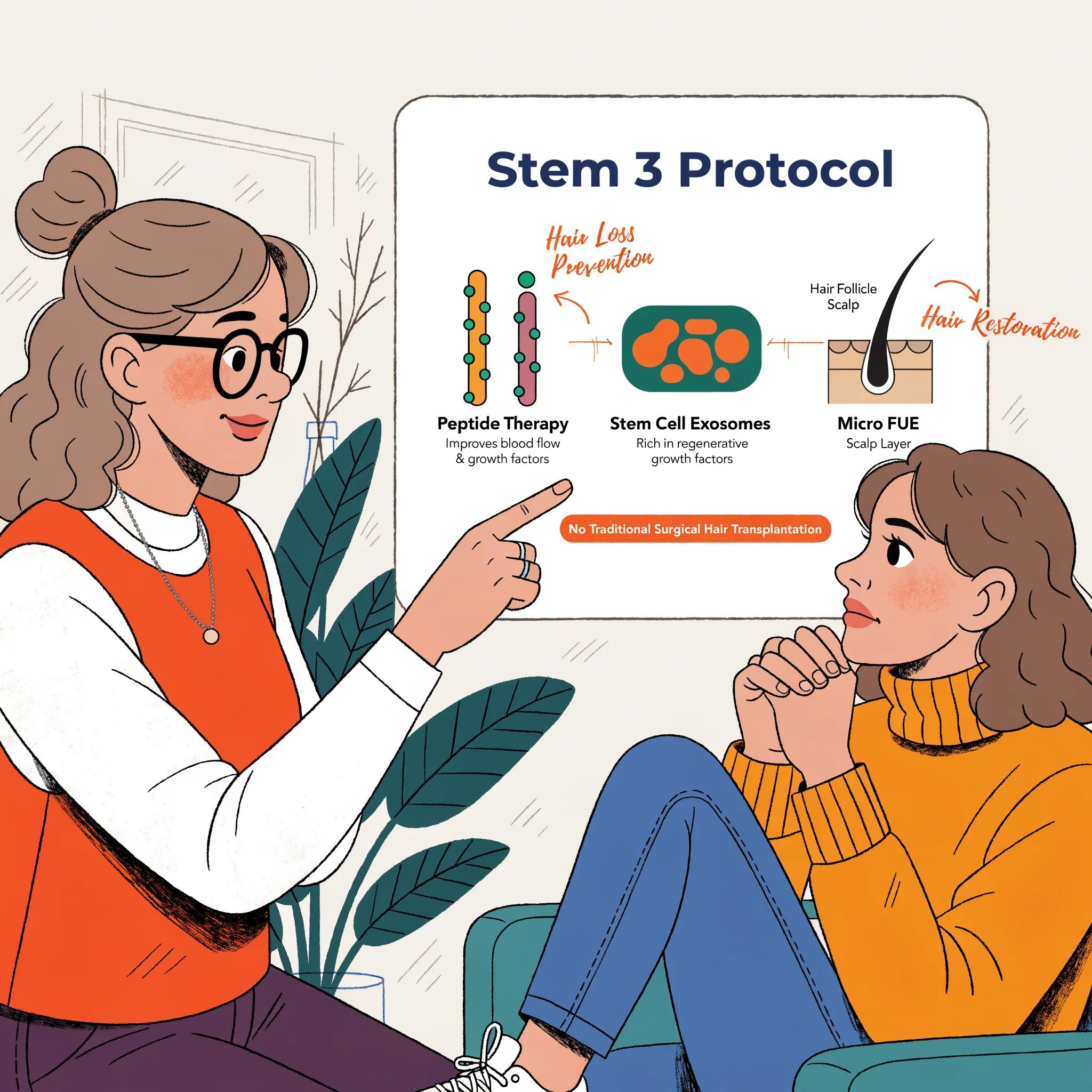
At Springs Rejuvenation's Austin location, Dr. Charles Pereyra, MD, a member of the International Society of Hair Restoration Surgery (ISHRS), oversees a three-component protocol designed to integrate surgical precision with regenerative support.
The protocol begins with micro-follicular unit extraction (micro-FUE), using 0.9 mm extraction tools to harvest and place grafts with minimal visible scarring. This surgical step addresses areas of complete follicle loss where grafts are necessary.
Following surgical placement, patients receive Muse cell or exosome-based scalp support. The rationale is that these biological factors may influence the local environment, potentially supporting graft survival and the health of surrounding follicles. The exact mechanisms in human scalp tissue are not fully understood, and results are not certain.
Physician-led follow-up is the third component. Dr. Charles Pereyra evaluates healing, monitors for any adverse responses, and adjusts care plans as needed. This structured oversight distinguishes a medical protocol from a purely cosmetic service.
Candidacy, Realistic Timelines, and What Patients Should Know
Not every individual experiencing hair loss is a suitable candidate for stem cell hair therapy in Austin or elsewhere. Dr. Pereyra conducts a detailed screening to assess scalp health, the pattern and extent of hair loss, medical history, and realistic expectations.
Patients should understand that hair restoration is a slow biological process. A shedding phase often occurs in the first weeks after any hair procedure, which can be alarming but is typically transient. First signs of new growth may appear around three to four months, with more noticeable changes emerging between six and nine months. Full assessment of outcomes generally requires nine to twelve months, and individual responses vary.
There is no therapy with certain outcomes. Some patients see meaningful improvement, others see modest changes, and some see little response. Published studies consistently report heterogeneity in results, and this uncertainty must be part of any informed decision.
Comparing Stem Cell Therapy to PRP and Exosomes
Platelet-rich plasma has been used for hair restoration longer than stem cell approaches, with a larger body of published evidence. However, as the 2019 systematic review by Gentile and Garcovich highlighted, PRP studies show variable results, and standardization of preparation methods remains a challenge.
Exosomes—small vesicles secreted by cells that carry signaling molecules—represent another investigational avenue. Some clinics promote exosome therapy as "stem cells without the cells," but the evidence base is even thinner than for whole-cell therapies, and regulatory clarity is lacking.
Stem cell hair therapy in Austin, particularly when using Muse cells, is grounded in a different biological rationale: the hypothesis that living cells with homing and signaling capacity may offer advantages over acellular preparations. Whether this hypothesis holds true in controlled clinical trials is a question the field has not yet definitively answered.
The Austin Context and US-Based Care
For years, patients interested in advanced regenerative therapies for hair loss often considered traveling to clinics in Mexico, Colombia, or other international destinations. The availability of physician-supervised Muse cell therapy in the US, including at the Springs Austin clinic, offers an alternative without the logistical and follow-up challenges of overseas care.
US-based care allows for continuity of physician oversight, easier access to follow-up visits, and adherence to domestic practice standards. While this does not alter the investigational nature of the therapy or its uncertain outcomes, it does change the context in which care is delivered.
How is a physician-led hair consultation different from a sales consultation?
A physician-led consultation prioritizes medical suitability over transaction. Dr. Pereyra reviews your scalp health, medical history, and asks about medications or conditions that might affect candidacy. He explains what the evidence does and does not support, discusses realistic timelines, and may recommend against the procedure if expectations cannot be met. A sales consultation, by contrast, emphasizes enrollment and may minimize limitations or uncertainties. Physician oversight means someone trained in clinical decision-making is guiding your care, not a commission-driven representative.
What does the recovery timeline look like?
Recovery varies by individual. Immediately after micro-FUE and scalp therapy, mild swelling, tenderness, and redness are common and typically resolve within a few days. A shedding phase often occurs around weeks two through four, which is expected. New growth may begin around month three or four, with more visible changes by six to nine months. Full assessment requires nine to twelve months. Some discomfort and temporary cosmetic concerns are normal, but serious complications are rare when the procedure is performed under physician supervision.
What does current evidence tell us about outcomes?
The published evidence on stem cell approaches to hair restoration is limited and early-stage. Studies on Muse cells have focused primarily on safety and biological mechanisms, not hair-specific outcomes. Research on related therapies like PRP and adipose-derived cell preparations shows mixed results, with some patients experiencing measurable improvement and others seeing little change. No therapy has uniformly positive results, and the literature consistently reports individual variability. Prospective patients should enter with realistic expectations and understand that investigational therapies carry inherent uncertainty.
How does US-based care differ from traveling overseas?
US-based stem cell hair therapy in Austin offers logistical simplicity, continuity of care, and the ability to return for follow-up without international travel. Physician licensing, facility standards, and recourse in the event of complications differ meaningfully between jurisdictions. Overseas clinics may offer therapies unavailable domestically, but evaluating credentials, verifying safety protocols, and managing complications from abroad can be challenging. Choosing a US-based physician means working within a familiar regulatory and medical-legal framework, which many patients find reassuring even when the therapy itself remains investigational.
Medical Disclaimer: Stem cell and exosome therapy is not an FDA approved therapy and is considered to be in the experimental stages. These statements have not been evaluated by the FDA and are not intended to diagnose, treat, cure, or prevent any disease. Springs Rejuvenation processes exosomes in an FDA approved lab. Individual results may vary. This content is reviewed for medical accuracy by Dr. Charles Pereyra, MD, Medical Director of Springs Rejuvenation, and is provided for educational purposes only. Always consult a qualified physician.