
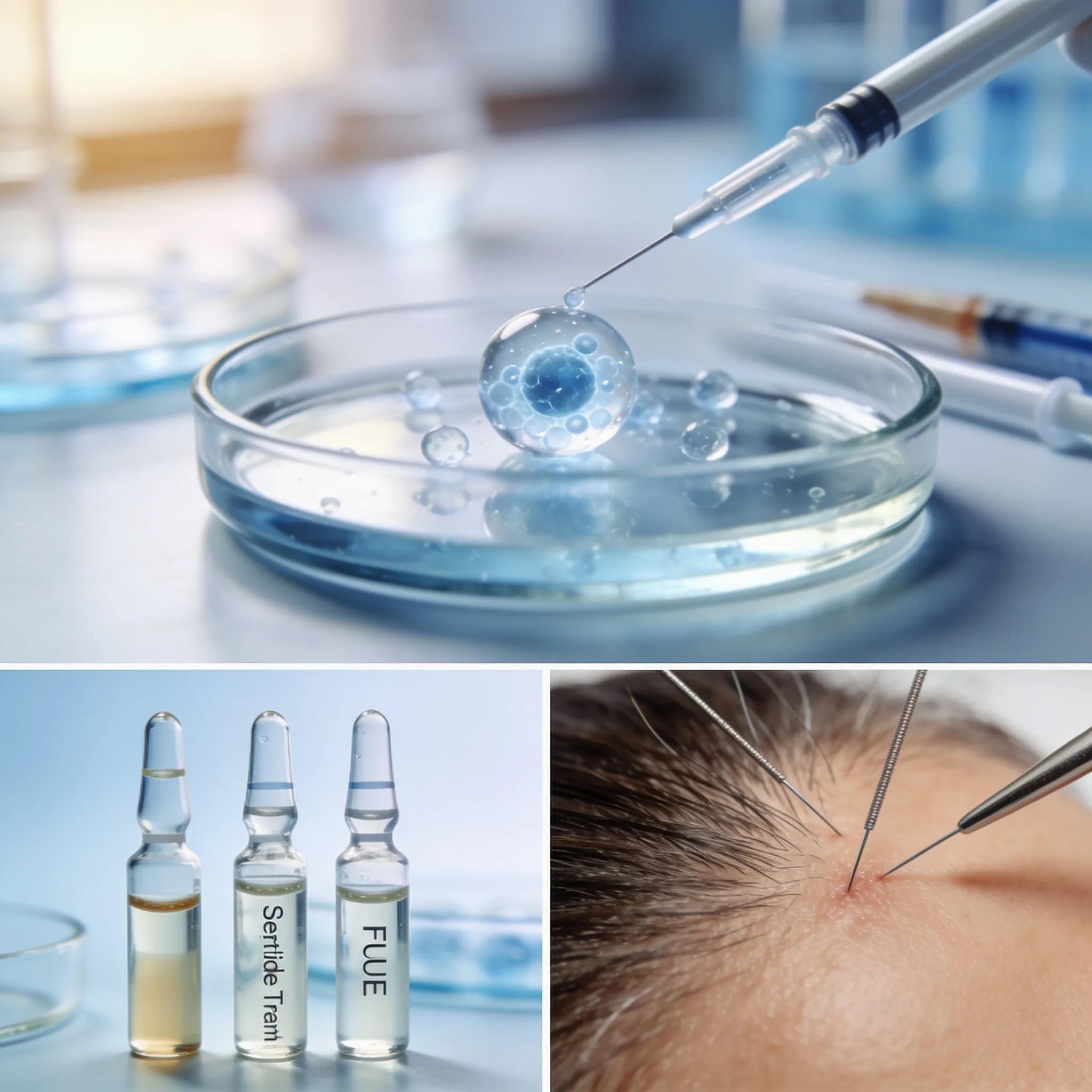
Stem Cell Hair Therapy in Atlanta: Evidence, Screening, Expectations
Medically reviewed by Dr. Charles Pereyra, MD — Medical Director, Springs Rejuvenation. Last reviewed November 2, 2026.
Written by the Springs Rejuvenation regenerative medicine team from direct clinical experience administering stem cell and exosome protocols at our Aventura, Miami center.
Hair loss affects millions of adults, and the search for biologically active therapies has led patients and researchers to explore regenerative approaches. Among the terms appearing in patient searches—PRP, exosomes, stem cell hair therapy atlanta—the underlying question is the same: what does the published evidence show, and what should a candidate know before committing to any protocol? This guide examines the current state of stem cell-based hair therapy, the mechanisms under investigation, and what physician-led screening at Springs Rejuvenation in Atlanta entails.
What the Published Evidence Shows About Stem Cell Approaches to Hair Loss
The literature on regenerative therapies for androgenetic alopecia is early-stage and mixed. A 2019 systematic review by Gentile and Garcovich surveyed the use of platelet-rich plasma for hair loss and found modest evidence of benefit in selected patients, though study designs varied and results were not uniform.
Shin and colleagues (2015) published a small pilot study examining adipose-derived stem cell conditioned media applied to the scalp. Participants showed some increase in hair density, but the cohort was limited and follow-up short.
More recently, attention has turned to a distinct population of pluripotent-like cells called Muse cells. Kuroda, Dezawa, and collaborators (2010) first characterized these SSEA-3-positive cells as naturally occurring in adult bone marrow and other tissues.
Yamada and colleagues (2018) demonstrated that intravenously delivered Muse cells can home to damaged tissue through an S1P–S1PR2 signaling axis. While that work focused on a preclinical model, the homing mechanism has implications for any tissue-repair application, including scalp follicle environments.
A first-in-human Japanese safety study (Noda 2020) tested intravenous Muse cells and reported acceptable tolerability. A subsequent randomized double-blind Japanese trial (Niizuma 2023) found modest outcomes, not uniformly positive across all measures. The literature is investigational, and individual responses vary.
Muse Cells, Exosomes, and PRP: Understanding the Differences
Patients researching stem cell hair therapy atlanta often encounter three categories: platelet-rich plasma, exosomes, and live Muse cells. PRP concentrates growth factors from the patient's own blood. Exosomes are membrane-bound vesicles secreted by cells, carrying signaling molecules. Muse cells are a subset of mesenchymal stem cells with pluripotent markers and tissue-homing capacity.
Each approach rests on a different hypothesis about what drives follicle regeneration. PRP delivers local growth factors. Exosomes may carry paracrine signals that alter the follicle microenvironment. Muse cells, according to the Yamada (2018) model, circulate systemically and migrate to areas of tissue stress.
No approach is FDA-approved for hair loss. All remain under investigation. The evidence base for PRP is broader but not definitive; exosome and Muse cell data are newer and smaller. When choosing a protocol, candidates should ask about the specific cell type, whether it is autologous or allogeneic, and what follow-up data the clinic collects.
The Stem 3 Protocol: A Physician-Led Approach in Atlanta
At Springs Rejuvenation's Atlanta location, Dr. Charles Pereyra, MD, a member of the International Society of Hair Restoration Surgery (ISHRS), screens candidates for a three-component protocol called Stem 3. The sequence combines micro-follicular-unit extraction, Muse cell support, and exosome application.
Micro-FUE involves placing individual grafts using 0.9-millimeter instruments, minimizing visible scarring. Once grafts are positioned, Muse cells are delivered intravenously to support tissue remodeling, and exosomes are applied topically to the scalp. The hypothesis is that combining structural grafting with biological signals may improve follicle survival and surrounding scalp health.
Dr. Pereyra emphasizes that this is not a standalone hair-restoration procedure. The grafting component addresses areas of permanent loss; the Muse and exosome components are investigational support strategies. Candidates undergo lab screening, medical-history review, and scalp examination before any protocol begins.
Because Muse cell therapy is available at Springs locations in the United States, patients no longer need to travel overseas to access physician-supervised protocols. That said, availability does not imply certainty of outcome. Every therapy, including investigational ones, carries individual variability.
Candidacy Assessment and Realistic Timelines
Not every patient is a suitable candidate for stem cell hair therapy atlanta protocols. Dr. Charles Pereyra evaluates several factors: the pattern and extent of hair loss, the health of remaining follicles, prior therapies attempted, and realistic expectations.
Timeline expectations are critical. Most protocols involve an initial shedding phase in the first six to eight weeks as transplanted grafts enter a rest cycle. Early signs of new growth typically appear between three and four months. Full assessment of density, texture, and coverage requires nine to twelve months, and some patients continue to see changes beyond that window.
Individual responses vary. Some patients report noticeable improvement; others see minimal change. No therapy has certain outcomes, and the literature does not support blanket promises. Physicians who screen candidates honestly will discuss both the potential and the limitations before any procedure begins.
Stem Cell Hair therapy Atlanta: What to Expect During Your Consultation
When researching stem cell hair therapy atlanta, patients often ask what distinguishes a medical consultation from a sales pitch. At Springs Rejuvenation, the consultation begins with Dr. Pereyra reviewing your medical history, current medications, and prior hair-loss therapies. A scalp examination follows, assessing follicle density, miniaturization patterns, and scalp health.
Lab work is ordered to rule out thyroid dysfunction, iron deficiency, and hormonal imbalances that contribute to hair loss independent of androgenetic alopecia. If those conditions are present, addressing them becomes the priority before considering any regenerative protocol.
Dr. Pereyra explains the Stem 3 sequence step-by-step, describes what the published evidence shows and does not show, and outlines realistic timelines. If you are not a candidate—because of medical contraindications, unrealistic expectations, or insufficient viable follicles—he will say so. The goal is informed decision-making, not enrollment.
Cost, insurance limitations, and the investigational status of Muse and exosome components are discussed transparently. You leave the consultation with a written summary of your candidacy, the proposed protocol, and next steps if you choose to proceed.
Recovery and Follow-Up
Micro-FUE grafting involves small punch sites that typically supports within seven to ten days. Scalp redness and minor swelling are common in the first week. Exosome and Muse cell components do not require incisions, so recovery is primarily related to the grafting itself.
Patients return for follow-up at one month, three months, six months, and twelve months. Each visit includes scalp photography, density counts, and discussion of any concerns. If progress stalls or complications arise, the protocol is adjusted.
Lifestyle factors influence outcomes. Smoking impairs circulation; high stress accelerates hair shedding; nutritional gaps slow follicle growth. Dr. Pereyra's team provides guidance on optimizing those variables during the follow-up period.
Because the Muse and exosome components are investigational, Springs collects outcome data to contribute to the evolving evidence base. That data informs candidacy decisions for future patients and helps refine the protocol over time.
How is a physician-led hair consultation different from a sales consultation?
A physician-led consultation begins with diagnostics—labs, scalp examination, medical-history review—before discussing any protocol. Dr. Charles Pereyra will disqualify candidates who are not medically appropriate or whose expectations exceed what the evidence supports. A sales consultation begins with enrollment as the goal. The physician-led model prioritizes informed consent and realistic outcome prediction, even when that means declining a candidate.
What factors make someone a better or worse candidate for stem cell hair therapy?
Better candidates typically have diffuse thinning with viable follicles still present, recent-onset androgenetic alopecia, good overall health, and realistic timelines. Worse candidates include those with complete follicle loss over large areas, uncontrolled medical conditions, unrealistic expectations of rapid results, or a history of poor response to prior therapies. Scalp inflammation and nutritional deficiencies also reduce candidacy until addressed.
How long before results become visible, and what does "results" mean?
Most patients enter a shedding phase in the first six to eight weeks as grafted follicles rest. Early signs of new growth appear between three and four months. Full density assessment requires nine to twelve months. "Results" vary widely: some patients see noticeable improvement in coverage and thickness; others see stabilization of loss without significant regrowth; a subset sees minimal change. No therapy produces certain outcomes, and the investigational nature of Muse and exosome components means the evidence base remains limited.
What does the research say about safety and side effects?
Early-stage studies, including a first-in-human Japanese safety study (Noda 2020), reported acceptable tolerability for intravenous Muse cells. Common side effects of micro-FUE grafting include temporary scalp redness, swelling, and minor discomfort at punch sites. Exosome application is minimally invasive. Serious adverse events are rare in published cohorts, but long-term data remain limited. Any investigational therapy carries unknown risks, and candidates should weigh those uncertainties during the informed-consent process before proceeding.
Medical Disclaimer: Stem cell and exosome therapy is not an FDA approved therapy and is considered to be in the experimental stages. These statements have not been evaluated by the FDA and are not intended to diagnose, treat, cure, or prevent any disease. Springs Rejuvenation processes exosomes in an FDA approved lab. Individual results may vary. This content is reviewed for medical accuracy by Dr. Charles Pereyra, MD, Medical Director of Springs Rejuvenation, and is provided for educational purposes only. Always consult a qualified physician.