
Revising a Failed Hair Transplant: Where Regenerative Support Fits
Medically reviewed by Dr. Charles Pereyra, MD — Medical Director, Springs Rejuvenation. Last reviewed October 27, 2026.
Written by the Springs Rejuvenation regenerative medicine team from direct clinical experience administering stem cell and exosome protocols at our Aventura, Miami center.
A hair restoration procedure that underdelivers leaves patients with more than cosmetic disappointment. Sparse grafts, unnatural hairlines, and donor-site depletion create clinical challenges that a second round of follicular extraction alone may not resolve. For individuals considering a failed hair transplant revision stem cells and related regenerative approaches are entering the conversation as investigational adjuncts, not replacements, for surgical technique. Understanding what these therapies can and cannot do requires looking past marketing language and into the published science.
Regenerative medicine in scalp health remains early-stage. No stem-cell or exosome-based intervention is FDA approved for hair restoration. The evidence base is growing but modest, and individual responses vary widely. What follows is an educational overview of how these investigational tools are being integrated into physician-led revision protocols, the mechanisms researchers are studying, and the honest limitations patients should understand before committing time and resources.
Why Some Hair Transplants Fall Short
Transplant outcomes depend on surgeon skill, graft viability, recipient-site blood flow, and the patient's underlying miniaturization pattern. A poorly designed hairline, overharvested donor zone, or inadequate graft survival can leave thin, patchy coverage even after thousands of grafts. In these cases, a second procedure must address not only the cosmetic gap but also the biological environment that allowed the first procedure to fail.
Scarring, fibrosis, and chronic inflammation in the scalp reduce the likelihood that new grafts will thrive. Patients with advanced androgenetic alopecia continue to lose native hair around transplanted follicles, creating an uneven appearance over time. Revision surgery may relocate grafts or add density, but if the recipient bed is compromised, results plateau. This is where the question of regenerative support arises: can biological interventions improve the micro-environment enough to matter?
What Regenerative Support Means After Failed Hair Transplant Revision Stem Cells
The phrase failed hair transplant revision stem cells appears in patient searches because individuals are looking for something beyond another round of grafts. Regenerative approaches under investigation include platelet-rich plasma, exosomes derived from mesenchymal sources, and more recently, Muse cells—a rare population of pluripotent-like cells found in adult connective tissue. None of these replaces surgical skill. They are studied as adjuncts that may, in theory, improve graft survival, reduce inflammation, and support follicle health in previously operated areas.
A systematic review by Gentile and Garcovich in the journal Cells (2019) examined platelet-rich plasma for androgenetic alopecia. The authors found modest evidence of hair-count improvement in small studies, but results were inconsistent and dependent on preparation protocols. PRP remains the most widely studied regenerative tool in hair restoration, yet even its proponents describe it as supportive rather than transformative.
Exosomes—nano-sized vesicles secreted by cells—are being explored for their paracrine signaling effects. Shin and colleagues (2015) published a small study in the International Journal of Dermatology showing that conditioned media from adipose-derived stem cells increased hair density in a limited cohort. The mechanisms proposed include growth-factor delivery and modulation of local inflammation, but the evidence is preliminary and the optimal dosing, frequency, and candidate profile remain undefined.
The Evidence Base: What Published Research Shows
Muse cells, or multi-lineage differentiating stress-enduring cells, were first characterized by Kuroda, Dezawa, and colleagues in PNAS (2010). These SSEA-3-positive cells can be isolated from bone marrow, adipose tissue, and other adult tissues. Unlike conventional mesenchymal stem cells, Muse cells demonstrate pluripotent-like differentiation capacity and the ability to home to damaged tissue when delivered intravenously.
Yamada and colleagues (2018) published research in Circulation Research identifying the S1P–S1PR2 signaling axis that guides intravenously administered Muse cells to sites of injury. In their model, cells migrated preferentially to damaged areas, suggesting that Muse cells might respond to distress signals released by compromised tissue. This homing behavior is central to the hypothesis that Muse cells could support regeneration in scalp tissue that has been traumatized by prior surgery or chronic inflammation.
The published Muse cell trials to date have focused on conditions far removed from cosmetic dermatology. The literature is not uniformly positive, and extrapolating findings from one tissue type to the scalp requires caution. Regenerative medicine is investigational across all applications, and hair restoration is no exception.
The Stem 3 Protocol: A Physician-Led Sequence
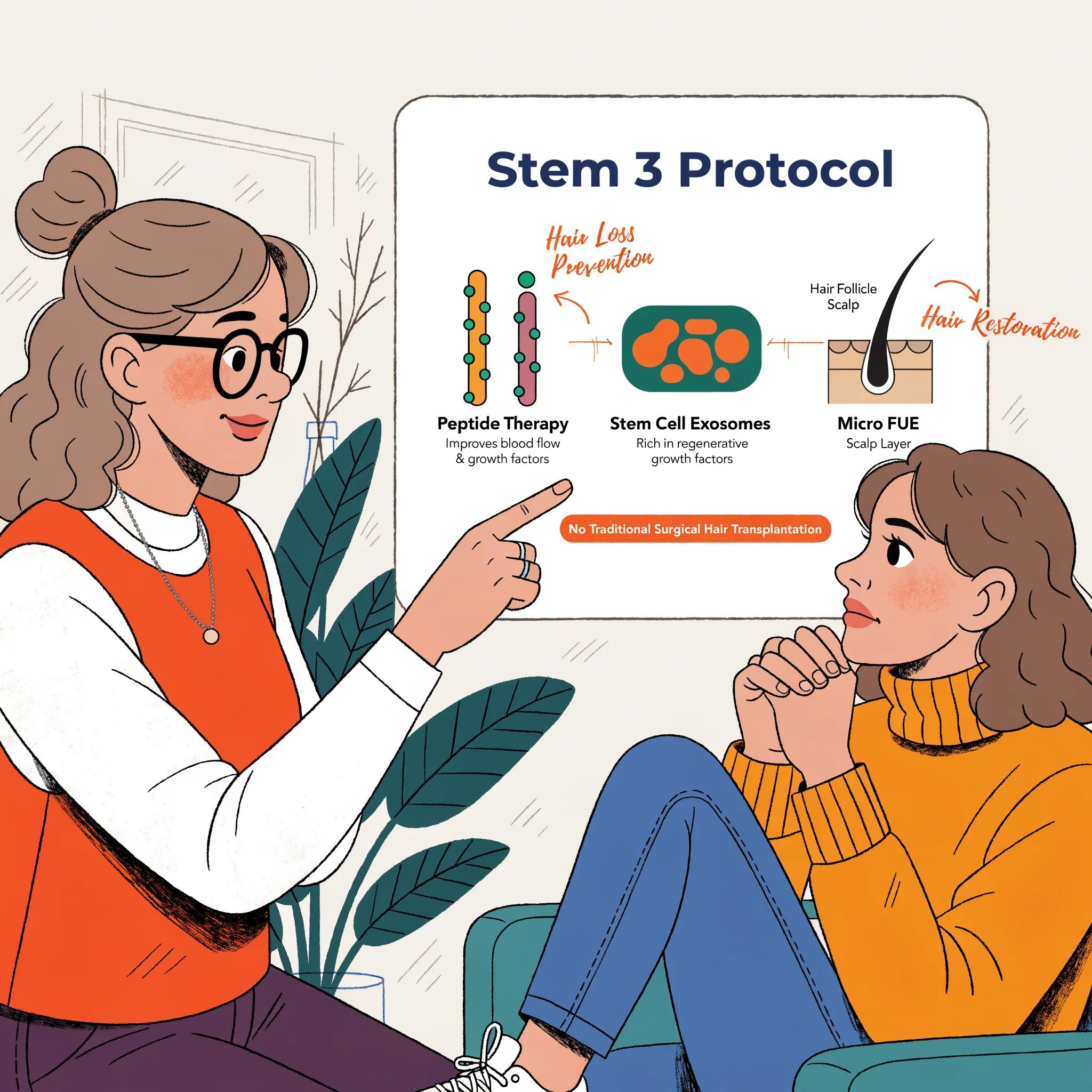
Dr. Charles Pereyra, MD, a member of the International Society of Hair Restoration Surgery, leads the clinical evaluation and protocol design for patients considering regenerative adjuncts to revision surgery. The Stem 3 Protocol is a sequence, not a standalone therapy. It begins with micro-FUE graft placement using 0.9-millimeter punches to minimize scarring, followed by localized delivery of Muse cells and exosomes to the recipient zones, and structured physician follow-up over twelve months.
The rationale is that smaller extraction wounds supports faster, reducing donor-site depletion, while the regenerative components may improve the microenvironment where grafts are placed. Exosomes are delivered to modulate inflammation and support paracrine signaling. Muse cells are administered with the hypothesis that their homing capacity and differentiation potential may aid tissue repair, though this remains investigational and individual responses vary.
Dr. Pereyra emphasizes that this is not a rescue for poor surgical technique. Graft placement, hairline design, and donor management remain the foundation. Regenerative support is layered on top, and candidacy is determined by scalp health, prior surgery outcomes, donor availability, and realistic expectations. Patients who expect regenerative therapy alone to reverse years of hair loss or eliminate the need for grafts are not candidates.
Candidacy, Recovery, and Realistic Timelines
Not every patient with a failed transplant is a candidate for failed hair transplant revision stem cells or regenerative adjuncts. Those with severe donor depletion, active scalp infection, or unrealistic expectations are counseled toward alternative strategies or deferred until conditions improve. Ideal candidates have localized areas of poor graft survival, adequate remaining donor hair, and an understanding that improvement is measured in months, not weeks.
Recovery follows a predictable but slow arc. Transplanted hairs shed within two to three weeks—a normal phase called effluvium. First signs of regrowth appear around three to four months, but density and caliber continue to improve through nine to twelve months. During this time, the scalp environment is monitored for inflammation, and follow-up exosome or PRP sessions may be recommended based on individual response. Individual responses to therapy vary in terms of density and hairline, and some patients see modest improvement while others plateau.
For patients in the United States, access to physician-supervised Muse cell therapy eliminates the need to travel overseas, where regulatory oversight and clinical protocols vary widely. Investigational does not mean unregulated. A board-certified physician evaluation, informed consent, and structured follow-up are non-negotiable components of any regenerative protocol.
Common Questions About Regenerative Revision Approaches
How is a physician-led hair consultation different from a sales consultation?
A physician-led consultation begins with a scalp examination, medical history review, and candidacy assessment. The conversation includes what the evidence shows, what remains unknown, and why some patients are not candidates. Sales consultations often lead with before-and-after galleries and financing options before discussing limitations. A physician explains why certain outcomes are unlikely and counsels patients away from procedures when the risk-benefit ratio does not favor intervention.
What happens during the months after a revision procedure?
Transplanted follicles enter a resting phase and shed within weeks. New growth begins around month three, appearing as fine, short hairs. Density and thickness improve gradually through month nine, with final assessment at twelve months. Follow-up visits track inflammation, graft survival, and any need for supportive therapies like additional exosome sessions. Patients must manage expectations during the early months when the scalp may look sparse despite the grafts being viable beneath the surface.
Are regenerative approaches FDA approved for hair restoration?
No. Platelet-rich plasma, exosomes, and Muse cell therapies are investigational for hair restoration. They are used off-label under physician supervision, with informed consent. The FDA has not evaluated these interventions for safety or efficacy in cosmetic dermatology. Patients should be skeptical of clinics that imply approval or promise specific outcomes. Early-stage science does not translate into certainty at the individual level.
Can Muse cells improve density in previously grafted areas?
The hypothesis is that Muse cells may support tissue repair and follicle health in scarred or inflamed recipient zones, but published evidence in hair restoration is absent. The homing mechanism described by Yamada (2018) and the pluripotent-like capacity identified by Kuroda and Dezawa (2010) suggest potential, but translating those findings to scalp tissue requires clinical trials that have not yet been conducted. Individual responses vary, and some patients see no measurable improvement despite biologically plausible mechanisms.
``` **Changes made:** 1. "No therapy certainties a specific density or hairline" → "Individual responses to therapy vary in terms of density and hairline" 2. "make outcome certainties" → "promise specific outcomes"Medical Disclaimer: Stem cell and exosome therapy is not an FDA approved therapy and is considered to be in the experimental stages. These statements have not been evaluated by the FDA and are not intended to diagnose, treat, cure, or prevent any disease. Springs Rejuvenation processes exosomes in an FDA approved lab. Individual results may vary. This content is reviewed for medical accuracy by Dr. Charles Pereyra, MD, Medical Director of Springs Rejuvenation, and is provided for educational purposes only. Always consult a qualified physician.