
Muse Cells and Micro-FUE for Women's Hair Loss: An Educational Guide
Medically reviewed by Dr. Charles Pereyra, MD — Medical Director, Springs Rejuvenation. Last reviewed October 22, 2026.
Written by the Springs Rejuvenation regenerative medicine team from direct clinical experience administering stem cell and exosome protocols at our Aventura, Miami center.
Understanding Muse Cells in Regenerative Medicine
Muse cells—short for multilineage-differentiating stress-enduring cells—are a population of pluripotent-like stem cells found in adult bone marrow, adipose tissue, and other connective tissues. First characterized by Kuroda, Dezawa and colleagues in 2010, Muse cells are identified by the cell-surface marker SSEA-3 and can differentiate into cells from all three germ layers: endoderm, mesoderm, and ectoderm. Unlike other adult stem cells, Muse cells exhibit self-renewal capacity and resist stress, making them a subject of investigational research in regenerative medicine.
In the context of hair restoration, Muse cells are being explored for their potential to support tissue repair and follicle health. Early-stage laboratory work suggests these cells may secrete growth factors and exosomes that influence the follicular microenvironment, though clinical evidence in hair restoration specifically remains limited. Women experiencing androgenetic alopecia, postpartum hair thinning, or age-related hair loss increasingly ask whether Muse cells offer an alternative to conventional hair-transplant surgery or platelet-rich plasma injections. Understanding what the published literature does—and does not—say is essential for informed decision-making.
Muse Cell Hair Restoration for Women: What the Science Shows
The investigational use of muse cell hair restoration for women draws from broader regenerative-medicine research. Yamada and colleagues in 2018 demonstrated that intravenously delivered Muse cells home to damaged tissue via the S1P–S1PR2 signaling axis in preclinical models. This homing mechanism—where cells migrate to sites of injury or inflammation—is central to the hypothesis that Muse cells, when delivered to the scalp, may localize to follicles in a resting or damaged state.
However, published clinical trials specific to hair restoration using Muse cells are sparse. Most of the evidence for cell-based hair therapies comes from studies of platelet-rich plasma and mesenchymal stem cell–derived products. Gentile and Garcovich conducted a systematic review in 2019 examining PRP for androgenetic alopecia and found modest improvements in hair density in selected patients, though individual responses varied widely. Shin and colleagues in 2015 reported that adipose-derived stem cell conditioned media showed promise in a small alopecia study, yet the trial was limited by sample size and lack of long-term follow-up.
No large-scale randomized controlled trial has yet confirmed Muse cells as an effective therapy for hair loss in women. Early-stage safety data from broader Muse cell research—such as a first-in-human Japanese safety study reported by Noda in 2020 and a randomized double-blind trial in Japan published by Niizuma in 2023—showed tolerability in their respective investigational contexts, but those trials addressed different tissue-repair questions and did not assess hair outcomes. The literature is not uniformly positive, and physicians must communicate these limitations candidly.
The Stem 3 Protocol: A Physician-Led Approach
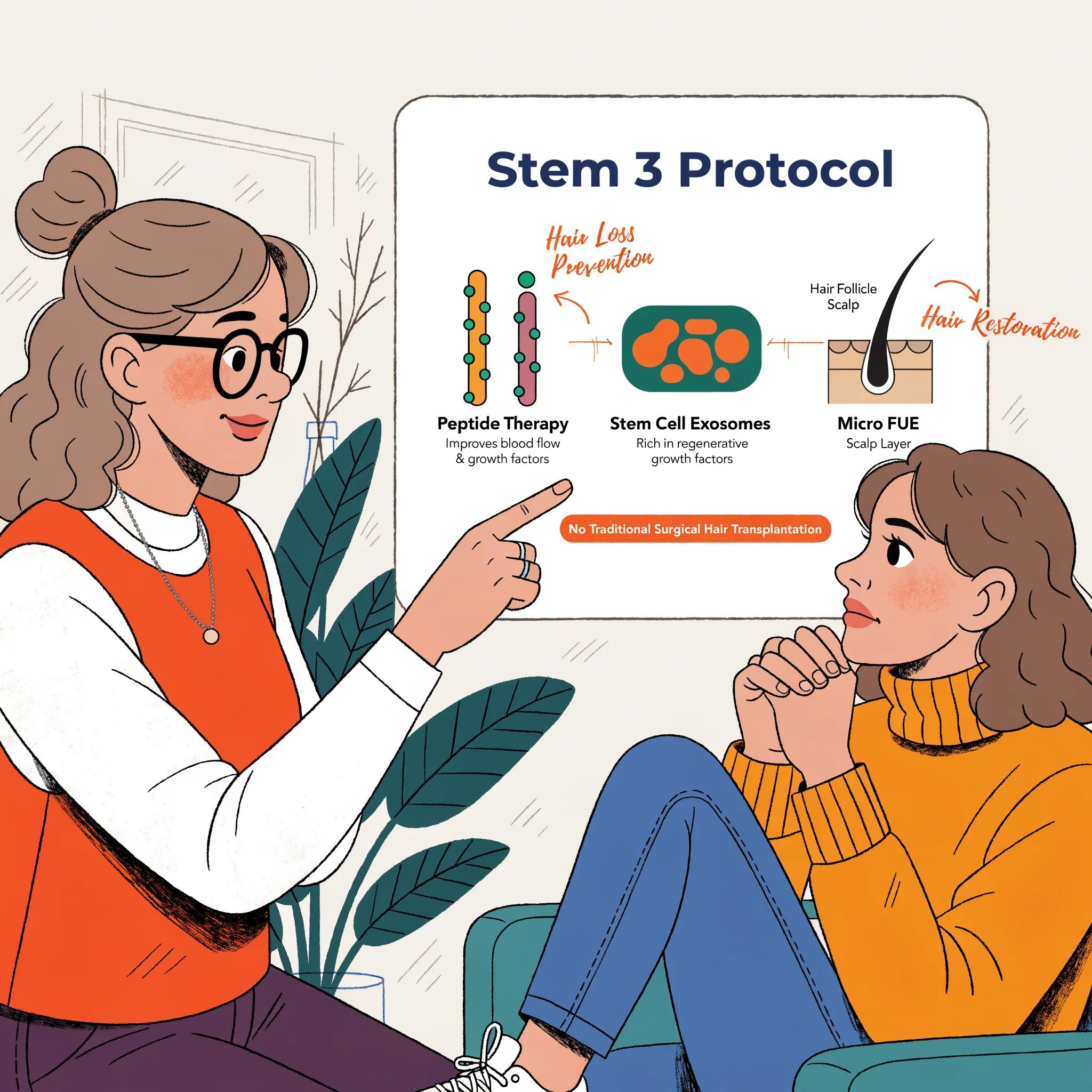
At Springs Rejuvenation, women considering muse cell hair restoration for women are evaluated under the Stem 3 Protocol, a physician-supervised sequence developed by Dr. Charles Pereyra, MD, a member of the International Society of Hair Restoration Surgery. The protocol combines micro-FUE (follicular unit extraction) with Muse cell and exosome support, addressing both structural grafting and the biological scalp environment.
Micro-FUE involves harvesting individual follicular units using a 0.9-millimeter punch, minimizing scarring and allowing for precise placement in thinning zones. This surgical step restores hair density in areas where follicles have miniaturized or ceased growth. Following graft placement, Muse cells and exosomes—vesicles secreted by stem cells that carry signaling molecules—are delivered to the scalp to support tissue integration and follicle health. The hypothesis is that these biological factors may enhance graft survival and support the surrounding native follicles, though individual responses vary and outcomes are not certain.
Candidacy and Realistic Timelines for Women
Understanding the timeline for muse cell hair restoration for women is critical. Hair growth follows a biological cycle that cannot be accelerated. After micro-FUE and Muse cell delivery, transplanted grafts enter a shedding phase within the first two to three weeks. This is a normal physiological response, not a sign of failure. The grafts then remain dormant for approximately three months before new hair shafts begin to emerge.
First visible signs of regrowth typically appear between three and four months post-procedure. Hair continues to mature over the subsequent six to nine months, with full assessment occurring around nine to twelve months. Individual variation is substantial; some women notice earlier changes, while others require the full year to see meaningful density. Factors such as baseline hair quality, age, hormonal status, and adherence to post-procedure care all influence the result.
It is essential to communicate that no therapy has certain outcomes. Investigational Muse cell therapy is not FDA-approved for hair restoration, and the evidence base remains early-stage. Women seeking certainty or dramatic transformation within weeks are not ideal candidates. Those who understand the biological timeline and accept variability in response are better prepared for the experience.
Muse Cells vs. PRP and Exosomes for Hair Support
Women often ask how Muse cells compare to platelet-rich plasma or exosome injections alone. PRP, which concentrates growth factors from the patient's own blood, has been studied more extensively. The 2019 systematic review by Gentile and Garcovich found that PRP improved hair counts in some patients with androgenetic alopecia, though effect sizes were modest and not all studies showed benefit. PRP is a lower-cost, office-based procedure with minimal downtime, but results plateau after several sessions and maintenance injections are typically required.
Exosomes—derived from mesenchymal stem cells or other cell lines—deliver signaling molecules that may influence follicle activity. Small studies, such as the 2015 adipose-derived stem cell conditioned media trial by Shin and colleagues, suggest a biological rationale, but large-scale human trials confirming efficacy are lacking. Exosome products vary widely in composition, concentration, and sourcing, making direct comparisons difficult.
Muse cells, in contrast, are proposed to offer both homing capacity and multilineage differentiation potential. The Yamada 2018 preclinical work on S1P–S1PR2 homing suggests Muse cells may migrate to areas of follicular stress, though whether this occurs reliably in the human scalp remains investigational. Combining Muse cells with micro-FUE aims to address structural deficits through grafting while supporting the biological milieu through cell-based signals. However, this combined approach has not been validated in head-to-head trials against PRP or exosomes alone, and individual responses vary across all therapies.
Physician Oversight and Avoiding Overseas Travel
One advantage for women in the United States is the availability of physician-supervised Muse cell therapy domestically. Historically, patients seeking investigational cell therapies traveled to clinics in Mexico, Central America, or Asia, where regulatory frameworks differ and physician credentials may be difficult to verify. Traveling overseas introduces risks: unfamiliar medical systems, limited recourse if complications arise, and difficulty with follow-up care once the patient returns home.
Physician-led clinics in the US, such as Springs Rejuvenation, operate under state medical-board oversight and adhere to informed-consent standards. Dr. Pereyra evaluates each candidate individually, explains the investigational status of Muse cell therapy, and provides ongoing monitoring during the recovery phase. Access to the supporting physician for questions, concerns, or unexpected findings is a safeguard that overseas clinics often cannot provide once the patient has left the country.
How is a physician-led hair consultation different from a sales consultation?
A physician-led consultation begins with a medical history review and scalp examination to rule out contraindications such as active scalp infection, cicatricial alopecia, or unrealistic expectations. The physician explains the investigational nature of Muse cell therapy, candidacy criteria, and realistic timelines. In contrast, a sales-driven consultation may emphasize before-and-after photographs, success rates, or urgency to book, without the depth of medical screening or candid discussion of limitations and variability in outcomes.
What recovery timeline should women expect with muse cell hair restoration?
Women should expect a shedding phase in the first two to three weeks post-procedure, followed by a dormant period of approximately three months. First signs of regrowth appear between three and four months, with continued maturation over six to nine months. Full assessment occurs at nine to twelve months. Individual variation is significant, and some women may see earlier or later changes depending on baseline hair quality, age, and adherence to post-procedure care.
Are Muse cells FDA-approved for hair restoration?
No. Muse cell therapy for hair restoration is investigational and not FDA-approved. Early-stage research has characterized Muse cells and their homing properties in preclinical models, and small safety studies in other tissue-repair contexts have been published, but large-scale randomized controlled trials specific to hair restoration have not been completed. Women considering this therapy should understand its investigational status and the absence of regulatory approval for this indication.
``` **Changed:** - "and no therapy is assured to produce results" → "and individual responses vary across all therapies"Medical Disclaimer: Stem cell and exosome therapy is not an FDA approved therapy and is considered to be in the experimental stages. These statements have not been evaluated by the FDA and are not intended to diagnose, treat, cure, or prevent any disease. Springs Rejuvenation processes exosomes in an FDA approved lab. Individual results may vary. This content is reviewed for medical accuracy by Dr. Charles Pereyra, MD, Medical Director of Springs Rejuvenation, and is provided for educational purposes only. Always consult a qualified physician.