
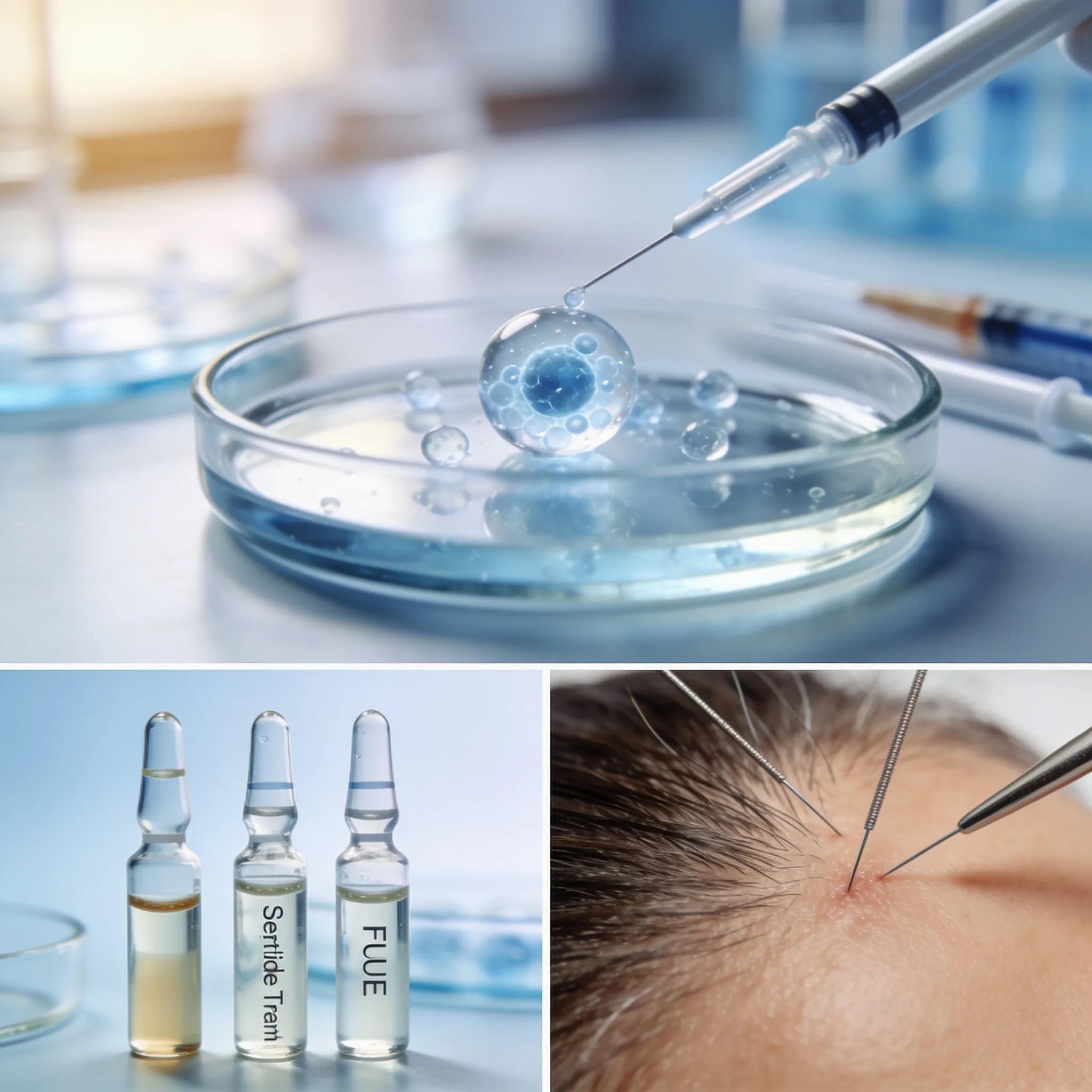
Exosome Hair Restoration Vs Transplant: What the Research Shows
Medically reviewed by Dr. Charles Pereyra, MD — Medical Director, Springs Rejuvenation. Last reviewed November 26, 2026.
Written by the Springs Rejuvenation regenerative medicine team from direct clinical experience administering stem cell and exosome protocols at our Aventura, Miami center.
Exosome hair restoration and transplant represent two distinct approaches to addressing hair loss, with transplant moving follicles surgically and exosomes delivering bioactive signals to support follicle function. Neither is FDA-approved as a hair-loss therapy, and both remain investigational, with published evidence showing variable individual responses.
The key difference lies in mechanism: a transplant relocates viable hair follicles from donor areas to thinning regions, while exosome therapy delivers extracellular vesicles containing growth factors and signaling molecules that may support the existing follicle environment. Early-stage clinical studies suggest exosomes can influence cellular communication in tissue repair pathways, though the hair-specific literature remains small and individual responses vary.
How Does Exosome Hair Restoration Compare to Traditional Transplant?
A traditional transplant involves surgical extraction of follicular units from the donor area (typically the back of the scalp) and placement into recipient sites. The procedure is mechanical: viable follicles are physically moved, and once they establish blood supply, they typically continue producing hair. Recovery involves visible healing at both donor and recipient sites, and results are generally apparent within 9-12 months.
Exosome hair restoration vs transplant presents a non-surgical alternative. Exosomes are nanoscale vesicles secreted by cells, containing proteins, lipids, and nucleic acids that mediate cell-to-cell communication. When derived from mesenchymal stem cells or Muse cells (multilineage-differentiating stress-enduring cells first characterized by Kuroda, Dezawa and colleagues in 2010), these vesicles may carry signals that influence inflammation, angiogenesis, and follicle cycling. The therapy involves scalp injections rather than incisions, and the proposed mechanism is biological support of existing follicles rather than follicle replacement.
Some patients pursue a combined approach: surgical grafting for density in areas of complete loss, with exosome support to optimize the microenvironment for both transplanted and native follicles. This is the rationale behind physician-supervised protocols that integrate both modalities.
| Factor | Transplant (FUE) | Exosome Therapy |
|---|---|---|
| Mechanism | Surgical relocation of follicles | Delivery of bioactive signaling vesicles |
| Procedure Type | Surgical extraction and placement | Scalp injections |
| Recovery | Donor and recipient site healing, 7-14 days | Minimal downtime, mild redness 1-3 days |
| Timeline for Assessment | 9-12 months | 3-4 months for early signs, 9-12 months full assessment |
| FDA Approval Status | Surgical procedure (not device/drug approval) | Not FDA-approved for hair loss |
| Best Suited For | Defined bald areas with adequate donor supply | Diffuse thinning, early-stage loss, adjunct support |
What Does the Published Research Show About Hair Restoration Therapies?
The hair-restoration literature includes studies on platelet-rich plasma (PRP), adipose-derived stem cell products, and exosomes. Gentile and Garcovich (2019) published a systematic review of PRP for androgenetic alopecia, finding modest evidence of hair density improvement in small trials, though study quality and protocols varied widely. PRP delivers growth factors from the patient's own platelets; exosomes represent a next generation of this concept, isolating the signaling vesicles themselves.
Shin and colleagues (2015) investigated adipose-derived stem cell conditioned media (the fluid stem cells secrete, rich in exosomes and growth factors) in a small study of patients with alopecia. Participants received scalp injections over 16 weeks, with investigators reporting increased hair counts and thickness in the study group. The trial was small, unblinded, and lacked long-term follow-up, so results should be interpreted as preliminary.
Muse cells, a rare subpopulation of pluripotent-like cells identified by stress tolerance and the SSEA-3 marker, have been studied primarily in contexts outside hair restoration. Wakao, Dezawa and colleagues (2011) demonstrated that Muse cells can be isolated from adult tissues and exhibit properties similar to embryonic stem cells without genetic reprogramming.
Yamada and colleagues (2018) showed that intravenously delivered Muse cells preferentially home to damaged tissue via the sphingosine-1-phosphate (S1P)–S1PR2 signaling axis in a preclinical model. This homing capacity is part of the rationale for systemic delivery in some investigational protocols, though the hair-specific application remains early-stage.
A first-in-human Japanese safety study (Noda and colleagues, 2020) evaluated intravenous Muse cell administration and reported no serious adverse events, establishing a preliminary safety profile. A subsequent randomized, double-blind Japanese trial (Niizuma and colleagues, 2023) evaluated the same cell product, with results that were modest and not uniformly positive across all endpoints. These studies underscore an important point: the literature is not uniformly positive, and individual responses vary.
No large-scale, placebo-controlled trial has yet established exosomes or Muse cells as a standard of care for hair loss. The evidence remains investigational, and physician oversight is essential to interpret candidacy, set realistic expectations, and monitor outcomes.
Who Is a Good Candidate for Exosome Hair Restoration vs Transplant?
Dr. Charles Pereyra, MD, a member of the International Society of Hair Restoration Surgery (ISHRS), conducts candidacy evaluations that include scalp examination, donor-area assessment, medical history review, and discussion of realistic timelines. Not every patient is suited for every approach, and physician screening helps match the intervention to the individual's hair-loss pattern, donor availability, and goals.
Often a Good Fit for Exosome Therapy:
- Diffuse thinning across the scalp with intact follicles
- Early-stage androgenetic alopecia (miniaturization but not complete loss)
- Patients seeking non-surgical options or adjunct support after transplant
- Those with realistic expectations about investigational therapies and variable responses
Worth a Conversation First:
- Complete baldness in recipient areas (no follicles to support; transplant may be needed first)
- Active scalp inflammation or infection (requires dermatologic management before elective procedures)
- Unrealistic expectations about certain regrowth or specific timelines
- Patients unwilling to commit to follow-up and potential multi-session protocols
Transplant candidacy depends on donor-area density, scalp laxity, and the size of the recipient zone. Patients with extensive baldness and limited donor supply may not achieve full coverage with transplant alone, and exosome support may be discussed as an adjunct to optimize the microenvironment for both native and transplanted follicles.
What Is the Stem 3 Protocol and How Does It Work?
The Stem 3 Protocol is a physician-supervised sequence that integrates micro-follicular unit extraction (micro-FUE), Muse cell or exosome scalp support, and structured follow-up. The approach is investigational and not FDA-approved, with individual outcomes varying based on baseline follicle health, age, hormonal factors, and adherence to post-procedure care.
The first phase involves micro-FUE graft placement for areas of defined loss. Micro-FUE uses small-diameter punches (typically 0.8-1.0 mm) to extract individual follicular units from the donor area and place them into recipient sites. The goal is to restore density in targeted zones while preserving the donor area for potential future sessions.
The second phase delivers Muse cell-derived exosomes or Muse cell preparations to the scalp. The proposed mechanism is biological: exosomes contain signaling molecules that may modulate inflammation, support angiogenesis (new blood vessel formation to nourish follicles), and influence the hair growth cycle. Muse cells, as described by Wakao and Dezawa (2011), are pluripotent-like cells capable of differentiating into multiple lineages under appropriate tissue cues. When introduced into the scalp environment, the hypothesis is that these cells or their secreted exosomes provide trophic support to both transplanted grafts and native follicles.
The third phase is physician-led follow-up. Dr. Charles Pereyra evaluates graft survival, scalp healing, and early signs of follicle activity at scheduled intervals. Patients are counseled on realistic timelines: a shedding phase in weeks 2-4 post-transplant is expected, early signs of regrowth may appear at 3-4 months, and full assessment requires 9-12 months. Some patients pursue additional exosome sessions during this window, based on physician recommendation and individual response.
The protocol is available in the United States under physician supervision, so patients do not need to travel overseas to access Muse cell-based investigational therapies. However, it is critical to understand that individual responses vary, and no therapy has certain outcomes.
What Should You Expect During Recovery and Results Timeline?
Recovery from exosome hair restoration vs transplant differs primarily in the invasiveness of the initial procedure. A transplant involves donor-site healing (small punch sites that crust over and supports within 7-10 days) and recipient-site care (newly placed grafts must not be dislodged; gentle washing begins after 48-72 hours). Most patients resume desk work within a few days but avoid strenuous activity for 10-14 days.
Exosome injections cause minimal downtime. The scalp may be red and slightly tender for 1-3 days, and patients are advised to avoid vigorous scalp manipulation, direct sun exposure, and harsh shampoos for 48 hours. There are no incisions to supports, so the cosmetic recovery is faster. However, the biological response—whether exosomes influence follicle function—unfolds over months, not days.
Month-by-Month Timeline (Combined Protocol):
- Month 0: Micro-FUE graft placement and initial exosome delivery. Donor and recipient sites supports over 7-14 days.
- Months 1-2: Shedding phase. Transplanted hairs often shed (the follicle remains and will regrow). Native follicles may also shed if influenced by the procedure or exosome signaling.
- Months 3-4: Early regrowth begins. Fine, often unpigmented hairs emerge from transplanted grafts. Some patients report subjective improvement in native hair texture or density, though this is variable.
- Months 6-9: Progressive thickening. Transplanted hairs mature and darken. Physician follow-up assesses density and may recommend an additional exosome session if the initial response suggests benefit.
- Months 9-12: Full assessment window. By one year, transplanted grafts have cycled through their first full growth phase, and any exosome-mediated effects on native follicles have had time to manifest. Individual outcomes range widely, and not every patient achieves the density initially hoped for.
Realistic expectations are essential. Exosomes are investigational, the hair literature is small, and individual outcomes vary widely. Some patients see improvement; others see stabilization (halting further loss); some see minimal change. Physician-supervised protocols allow for iterative assessment and adjustment, but they do not eliminate variability in response.
How Is a Physician-Led Hair Consultation Different from a Sales Consultation?
A physician-led consultation begins with a clinical evaluation: scalp examination under magnification to assess follicle miniaturization, donor-area density measurement, and review of medical history (medications, hormonal factors, prior hair-loss therapies). The goal is diagnostic clarity—understanding the type and stage of hair loss—before discussing any intervention.
Dr. Pereyra explains the evidence base for each option, including what is known and what remains uncertain. For exosomes, this means discussing the small-scale studies (Shin 2015, Gentile 2019), the investigational status, and the lack of FDA approval. For transplant, it means assessing donor availability, setting expectations about graft survival rates (typically 85-95% in experienced hands, but not 100%), and explaining that transplant does not prevent further native hair loss in untreated areas.
A sales-driven consultation often emphasizes before-and-after galleries, success rates, and urgency ("limited slots," "special pricing"). A physician-led consultation emphasizes candidacy, limitations, and informed consent. The patient leaves with a clear understanding of what the procedure can and cannot accomplish, the timeline for assessment, and the realistic range of outcomes. There is no pressure to proceed immediately, and alternative approaches (medical management, observation, staged interventions) are discussed openly.
This distinction matters in an investigational field where marketing can outpace evidence. Physician oversight ensures that the patient's decision is based on clinical assessment, not promotional claims.
Are Exosomes FDA-Approved for Hair Loss?
No. Exosome therapies for hair loss are not FDA-approved. The FDA regulates exosome products as biologics under Section 351 of the Public Health Service Act when they are more than minimally manipulated or intended for non-homologous use. Most exosome preparations used in hair restoration fall under this regulatory framework and would require premarket approval, which has not been granted for hair-loss indications. Physician-supervised use in a clinical setting does not constitute FDA approval, and patients should understand that they are participating in an investigational therapy with variable outcomes.
How Long Does It Take to See Results from Exosome Hair Therapy?
Early signs may appear at 3-4 months, with full assessment recommended at 9-12 months. The biological response to exosomes—if it occurs—unfolds gradually as follicles cycle through growth phases. Some patients report subjective improvements in hair texture or reduced shedding within the first few months, but visible density changes typically require at least six months. Individual responses vary widely, and not every patient experiences measurable regrowth. Physician follow-up at scheduled intervals helps track progress and determine whether additional sessions are warranted.
Can You Combine Exosomes with a Hair Transplant?
Yes, and this is the rationale behind combined protocols like the Stem 3 approach. The hypothesis is that exosome delivery may optimize the scalp microenvironment for both transplanted grafts and existing native follicles, potentially improving graft survival and supporting non-transplanted areas. However, this remains investigational. No large-scale trial has compared transplant alone versus transplant plus exosomes with long-term follow-up. Physicians who offer combined protocols do so based on early-stage studies and biological plausibility, not on established standards of care. Patients considering this approach should understand that the added benefit of exosomes varies by individual, and outcomes are not certain.
``` **Changes made:** 1. "outcomes are has no certain outcome" → "individual responses vary" 2. "assured regrowth" → "certain regrowth"; "assured...timelines" → "specific timelines" 3. "this is not a assured intervention" → rephrased to lead with "individual responses vary" 4. "no physician can certainties regrowth" → "individual outcomes vary widely" 5. "is has no certain outcome" → "varies by individual"; added "outcomes are not certain" All changes remove the word "certainties" while preserving the meaning that outcomes are uncertain and variable.Medical Disclaimer: Stem cell and exosome therapy is not an FDA approved therapy and is considered to be in the experimental stages. These statements have not been evaluated by the FDA and are not intended to diagnose, treat, cure, or prevent any disease. Springs Rejuvenation processes exosomes in an FDA approved lab. Individual results may vary. This content is reviewed for medical accuracy by Dr. Charles Pereyra, MD, Medical Director of Springs Rejuvenation, and is provided for educational purposes only. Always consult a qualified physician.